




Foot specialist Dr Shubhangi Tathare shares why annual foot check-up are crucial and help protect your well-being.
A case study
Mr John (name changed), 65 years old, had Diabetes for last eight years. He follows a healthy lifestyle. Diabetes has neither stopped him from living his life to the fullest nor has it interfered with his education, work or social life. Due to his family history of Diabetes, he accepted the diagnosis with equanimity. Mr John, a chemistry graduate travels frequently for work. He quit smoking 10 years ago after being a smoker for 30 years. He exercises regularly and goes to a yoga class thrice a week. He enjoys taking an hour long walk every day.
Mr John and his wife visited their son who lived abroad. During this trip, Mr John toured several historical monuments which required extensive walking. He also kept up his daily exercise routine to maintain his good health. During a morning walk with his son, he experienced severe pain after walking 100 meters. The pain originated in the back side of the left calf muscle and spread to the soles of his feet as a burning sensation. He could not move his leg forward. His son asked him to rest on a park bench. After sitting for a few minutes, Mr John felt better. To avoid the risk of
urther pain they took a taxi home. Mr John rested for the next few days but the pain did not go away. He continued to experience pain and a burning sensation after short walks. The pain would alleviate when he rested but reappeared after he started walking. These symptoms did not subside. Worried, his son took Mr John to a nearby hospital. Upon hearing his medical history, the doctor recommended Mr John to gets his legs checked for blockages.
Mr John’s family was very concerned about his leg pain. Upon returning to India, Mr John visited a Diabetes hospital with a specialized podiatry (foot care) department. Mr John explained that he had never had his feet health checked by a foot specialist as before as he never had any foot related problem. The foot specialist examined his legs and told him about the possibility of blockage which was responsible for the pain. Mr John’s foot pulses were also very week. Mr John was asked to get his blood glucose levels checked and to undergo the Ankle Brachial test and the Biothesiometer test (to detect the nerve damage) and the Arterial Doppler test (to detect the status of blood flow of the legs and feet).
The tests showed blockages in Mr John’s left leg. This indicated peripheral arterial disease (a condition where the blood flow towards the legs gets reduced or completely blocked) and he also had nerve damage termed as peripheral neuropathy (nerve damage due to Diabetes). His blood glucose levels were 380 mg/dL. Mr John was referred to a diabetologist who prescribed Insulin (to better manage his Diabetes) and drugs (to relieve pain) and blood thinners called antiplatelet (to improve the blood flow). Mr John was also referred to a physiotherapist who for 2
weeks supervised his exercise routine which was specially tailored to help alleviate the leg pain. Within a week, burning sensation in the sole lessened. But the pain persisted.
During his revisit he described the pain. His doctor advised immediate hospitalization to perform an angiogram (a test to detect the extent and degree of blockage). The angiogram showed 70 per cent blockage of a main artery and 30 per cent blockage of another major artery that supplied blood to the leg and foot. Mr John underwent angioplasty (a procedure to open up the blocked arteries with the intention of improving the blood flow). The angioplasty procedure helped improve blood flow to Mr John’s foot thereby alleviating the pain. Mr John was discharged after three days and was able to walk without any pain and was advised to keep an eye on his blood glucose levels and visit the foot specialist every 3 months for his check-up.
Prevent these problems
Mr John had never visited a foot specialist to evaluate his feet health. He was unaware about his risk of developing foot problems. It was unbearable pain that led him to visit a foot specialist. From the very first year of diagnosis of Diabetes, it is necessary to have an annual foot check-up. This rule holds true irrespective of the duration of onset of Diabetes. An annual check-up helps detect, manage and arrest problems at the early stage. The podiatrist’s foot care advice must be adhered to prevent, manage and arrest all foot related complications. Nerve damage is the most common culprit in people with Diabetes which lowers sensation in the feet often
masking these problems till they manifest in a severe pain or ulcer in the feet and legs affecting the individual’s quality of life.
Foot pain in Diabetes
People with Diabetes are at a higher risk of developing serious foot problems. The foot problems result from a combination of many factors – high and fluctuating blood glucose levels, longer duration of Diabetes and abnormal blood fat levels. Lifestyle choices like smoking and alcohol usage also increase risk. Higher blood glucose levels damage the nerves and blood vessels that supply blood to the legs – setting off a series of foot problems.
Diabetes and nerves (Peripheral Neuropathy)
Longer duration of Diabetes damages nerves leading to peripheral neuropathy. This results in silent and painful symptoms. Peripheral neuropathy is the most common cause of feet related pain. Diabetes affects basically three types of peripheral nerves: sensory, motor and autonomic.
Sensory neuropathy
A large percentage of people complain of pain due to sensory nerve damage called sensory neuropathy where the amount of pain is not proportional to the degree of discomfort it is causing. For instance, many individuals prefer to wear looser clothing to avoid pain caused by chaffing. Pain resulting from a single touch could be very painful. Pain and numbness in the feet can coexist. Sensory neuropathy symptoms include burning, tingling, shooting and electric shock kind of sensation. These symptoms vary from person to person.
Motor nerve damage
Involvement of motor nerve damage can contribute to another painful diabetic condition where the muscle becomes week and achy; it can also result in imbalance while walking, joint stiffness and deformities.
Autonomic nerve damage
Autonomic nerve damage can alter the sweating mechanism thus resulting in over dryness and fissures in the feet and legs. This acts as a portal of bacterial entry thus increasing the risk of cellulitis (bacterial infection) and pain which usually requires intravenous antibiotics, rest and local care to manage. It can also result in thickened nail and dry cuticles which results in pain.
Diabetes and blood vessels (Peripheral Arterial Disease)
Blood circulation problems in the feet may cause intense pain especially in people with Diabetes. In people with long
standing Diabetes and in people who smoke or consume tobacco in any form, the arteries that supply blood to the legs become narrow or completely blocked resulting in pain in the limb while waking or at rest. This is called peripheral arterial disease. Peripheral arterial disease is also seen in non-diabetic people who smoke.
Arteries feed fresh blood from the heart to all parts of the body. This fresh blood nourishes and provides oxygen to the body tissue. The blood enters and leaves the tissue through capillaries and returns to the heart to be replenished with oxygen and nourishment by way of the veins. This process is altered because of high blood glucose level, abnormal blood fat level and narrowing of arteries. The arteries most commonly affected are those behind the knee and the calf. Blood flow to the feet could then be partially or totally blocked and the tissue starves of oxygen resulting in extreme pain.
People with mild peripheral arterial disease can be completely without symptoms. However, as blood supply becomes progressively inadequate, it can cause claudication, rest pain, vascular ulcers and critical limb ischemia.
Claudication
Claudication is the development of pain in the calf after walking for a distance or up an inclined position. The distance a person can walk before such pain occurs is referred to as claudication distance. The leg and foot look and feel normal as long as the person is resting. As claudication distance becomes shorter and shorter, physical activities become more and more restricted. Regular exercise by walking through the pain threshold can sometimes
increase the claudication distance. In many cases to relieve the symptom it is necessary to have either an angioplasty or by-pass surgery (a vein from other part of the body is used to bypass the blockage, allowing blood to flow through).
Rest pain
Rest pain is foot pain even when at rest or when an individual is not walking. It is more severe when the person is lying on the bed sleeping and may awake due to severe, unbearable pain. It is important to avoid tobacco to lower risk of rest pain.
Vascular/ Ischemic ulcers
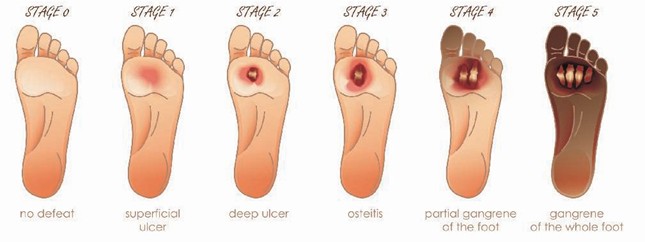
In the presence of severe arterial disease, people with Diabetes may suffer from painful ulcers which don’t heal because of inadequate blood supply. This results in painful vascular ulcer or gangrene which often requires amputation. A person with peripheral arterial disease should take care to avoid injury.
Critical limb ischemia
Critical limb ischemia is a more severe stage of peripheral vascular disease than claudication. The affected foot looks purplish in colour and feels cold to touch. On palpation, foot pulse may be very feeble or absent. Angioplasty and by-pass surgery are the only available treatment to manage critical limb ischemia. In some cases, amputation is required as the last option to relieve pain.
To conclude
People with Diabetes should regularly check their feet to prevent the problems occurring in the feet. Keep blood glucose under control and checking their feet annually may help diagnose the problems at early stage. Apart from this people with Diabetes may seek advice from their foot specialist about safe footcare practices and they may require specialized footwear which can be comfortable and soft. It is important to note that not all people with Diabetes can detect the pain of these problems and therefore should have their feet visually and manually inspected with specialised neuropathy blood flow assessment tools. Educating people about the condition of the feet is very important. Education is the real key to prevent amputation.
Dr Shubhangi Tathare is a Consultant Podiatrist.